

DPC Urges Kansas Governor to Sign Budget Bill to Protect 340B Program from Misuse
Today, the Domestic Policy Caucus wrote to Kansas Governor Laura Kelly, urging her to sign the state's budget bill, which includes a provision to protect the 340B program from further misuse in the state.
Today, the Domestic Policy Caucus wrote to Kansas Governor Laura Kelly, urging her to sign the state's budget bill, which includes a provision to protect the 340B program from further misuse in the state.
In the letter, DPC wrote in part, "By signing the budget bill, you will avoid creating an economic environment in which incentives would be put in place to encourage even more consolidation of healthcare systems, putting healthcare farther out of reach of rural Kansans, and imperiling the ability of underserved Kansans to receive the medications they need."
Read the full letter here.
Mass Priorities Publishes Issue Guide for Fairhaven, Massachusetts
Mass Priorities has published an issue guide for the town administrators and residents of Fairhaven, Massachusetts, to educate about the risks and costs of government-owned broadband networks.
Mass Priorities has published an issue guide for the town administrators and residents of Fairhaven, Massachusetts, to educate about the risks and costs of government-owned broadband networks.
In the issue guide, Mass Priorities explained, "At a time when Fairhaven faces a $2.2 million budget deficit, it's imperative to understand the implications of Article 11. Article 11 asks for two significant financial commitments from Fairhaven residents regarding a government-owned municipal broadband network. First, it seeks approval to borrow $20,645,527 to build the network. Second, it suggests setting up a Municipal Fiber Enterprise Fund, allowing further increases in spending beyond the initial borrowed amount in the years to come. With the town already facing significant fiscal challenges, the proposal to fund an unneeded pet project--a potential municipal broadband network--is an example of misplaced priorities."
Read the full issue guide here.
Mass Priorities Letter in Fairhaven Neighborhood News: Fairhaven Needs to Prioritize Spending
Mass Priorities Policy Director Christopher Thrasher recently had a letter to the editor published in the Fairhaven Neighborhood News, "Fairhaven Needs to Prioritize Spending."
Mass Priorities Policy Director Christopher Thrasher recently had a letter to the editor published in the Fairhaven Neighborhood News, "Fairhaven Needs to Prioritize Spending."
In part, the letter said, "At a time when municipal budgets are stretched thin, economic pressures are growing, and federal support is dwindling, the urgency to prioritize municipal spending on critical needs has never been greater, and the consequences of misplaced priorities can be dire."
Read the full letter here.
Utah State Auditor in Deseret News: Government-owned internet networks hurt taxpayers
Utah State Auditor John Dougall penned an op-ed for the Deseret News, calling out the harm that government-owned internet has inflicted on taxpayers in his state.
Utah State Auditor John Dougall penned an op-ed for the Deseret News, calling out the harm that government-owned internet has inflicted on taxpayers in his state.
In the op-ed, Dougall wrote, "The number of government-owned networks is increasing by the day, and taxpayers, not users, are often footing the bill. Government-owned broadband networks cost millions of dollars and divert essential funding away from services that really matter to the public — services such as police and fire, roads, water and sewer... Public officials across the country, and especially here in Utah, should resist the appealing allure of expanding or deploying government-owned networks, which allure has been shown to be deceptive, and ultimately destructive, to taxpayers."
Read the auditor's full commentary here.
Mass Priorities Launches "No Blank Check" Billboard Campaign in West Springfield
This week, Mass Priorities announced an expansion of its educational efforts in Western Massachusetts with the unveiling of a new billboard at the intersection of Route 5 and Interstate 91 in West Springfield.
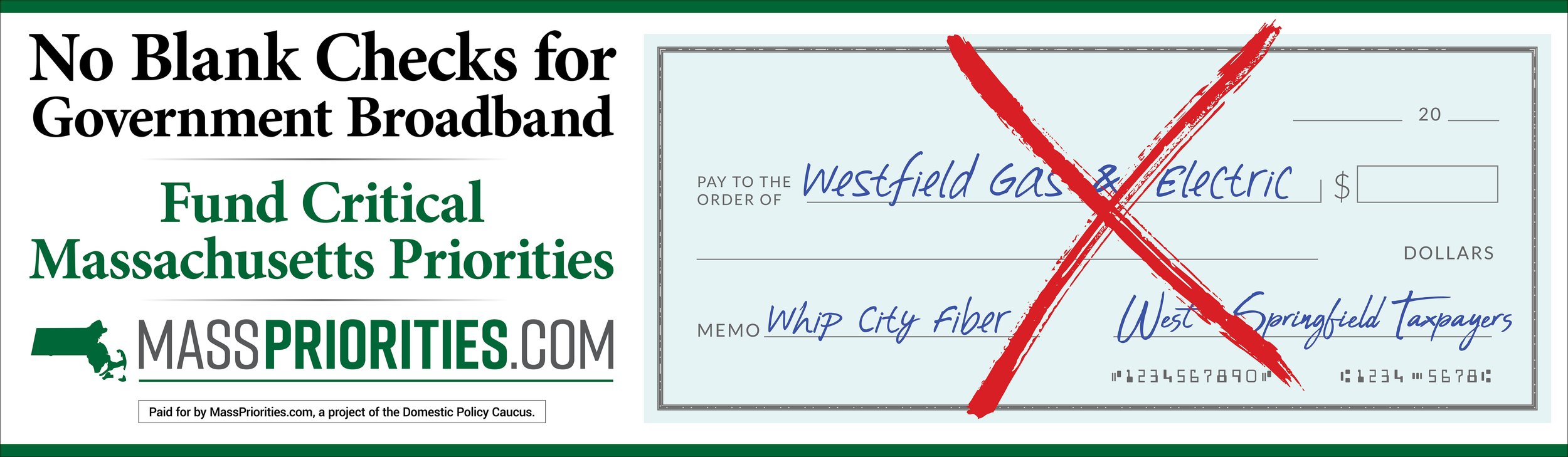
This week, Mass Priorities announced an expansion of its educational efforts in Western Massachusetts with the unveiling of a new billboard at the intersection of Route 5 and Interstate 91 in West Springfield.
“Mass Priorities is committed to advocating for responsible allocation of taxpayer dollars, emphasizing the importance of funding critical services such as education, public safety, and infrastructure over unnecessary pet projects,” said Christopher Thrasher, Mass Priorities policy director. “Today, we reaffirm our commitment to this mission with the unveiling of a striking billboard designed to capture the attention of West Springfield residents and municipal leadership alike.”
The billboard features a powerful visual—a blank check made out to Westfield Gas and Electric with the memo line reading “Whip City Fiber” and signed by West Springfield taxpayers. Accompanying this imagery is a bold message: “No Blank Checks for Government Broadband – Fund Critical Massachusetts Priorities.” This visual metaphor serves as a stark reminder of the potential misuse of taxpayer funds if not properly scrutinized.
The Mass Priorities educational campaign in Western Massachusetts seeks to emphasize the necessity of critical analysis and thoughtful expenditure of taxpayer resources, especially during times of economic uncertainty and dwindling federal support.
“As municipal budgets come under increasing strain, we must make prudent decisions to avoid cuts to essential services and threats to bond ratings,” said Thrasher. “By promoting fiscal diligence and accountability, we can safeguard the interests of taxpayers and ensure that the use of limited municipal funds focuses on real community priorities.”
Mass Priorities Expands Education Campaign into Western Massachusetts
Mass Priorities Policy Director Christopher Thrasher today announced a significant expansion of the organization’s campaign into Western Massachusetts.
Mass Priorities Policy Director Christopher Thrasher today announced a significant expansion of the organization’s campaign into Western Massachusetts.
“Amid growing economic pressures and dwindling federal support, Mass Priorities is launching an education campaign in Western Massachusetts to ensure taxpayer dollars are allocated to projects that provide tangible benefits to local communities, emphasizing the importance of funding critical services like education, public safety, and infrastructure over unneeded, unwanted pet projects,” said Thrasher.
“Local municipalities in Western Massachusetts and across the Commonwealth are facing significant shortfalls in revenue at the same time federal COVID and stimulus funds are ending,” said Thrasher. “This is creating immense fiscal pressure on local budgets, forcing tough decisions between cutting essential services or raising taxes on already stretched citizens. The urgency to prioritize municipal spending on critical needs has never been greater.”
As the campaign expands across the Commonwealth, Mass Priorities is sounding the alarm on potential threats to crucial municipal priorities. Mass Priorities will begin a multi-channel education and awareness initiative in Western Massachusetts this week.
“Our goal is to ensure that both the leaders and the citizens of Western Massachusetts communities are well-informed and prepared to make wise decisions with their limited taxpayer dollars,” said Thrasher. “It is imperative that we focus our resources on essential services and education, instead of throwing money at risky, unproven, and unnecessary non-critical projects.”
“With proper due diligence, the potential risks from misplaced priorities become clear: cuts to crucial services, threats to bond ratings, and looming peril to taxpayers. Mass Priorities is calling on municipal leaders to use comprehensive cost modeling for all community projects and to embrace the philosophy of look before you leap, know before you go, and trust but verify,” said Thrasher.
More information is available at www.MassPriorities.com.
DPC Urges Mississippi Governor to Veto 340B Expansion
Today, the Domestic Policy Caucus wrote to Mississippi Governor Tate Reeves, urging him to veto H.B. 728, a bill that would expand 340B in the state.
Today, the Domestic Policy Caucus wrote to Mississippi Governor Tate Reeves, urging him to veto H.B. 728, a bill that would expand 340B in the state.
DPC wrote, “H.B. 728 would create an economic environment in which incentives would be put in place to encourage even more consolidation of healthcare systems, to put healthcare farther out of reach of rural Mississippians, and to imperil the ability of underserved Mississippians to receive the medications they need, all while lining the pockets of big healthcare systems and giant chain pharmacies… The number of independently owned retail pharmacies declined by 16 percent in the United States between 2003 and 2021. That has contributed to the appearance of what are called “pharmacy deserts… Only Stone County has no pharmacy desert, and in more than 20 Mississippi counties, 100% of the residents live more than 15 minutes from the three closest pharmacies.
Read the full letter here.
DPC Urges Missouri Senators to Oppose 340B Expansion
The Domestic Policy Caucus wrote to Missouri Senate Leaders to vote against the expansion of 340B, the federal law on prescription drugs, which S.B. 751 currently under consideration would create in Missouri.
The Domestic Policy Caucus wrote to Missouri Senate Leaders to vote against the expansion of 340B, the federal law on prescription drugs, which S.B. 751 currently under consideration would create in Missouri.
DPC wrote, “S.B. 751 would create an economic environment in which incentives would be put in place to encourage even more consolidation of healthcare systems, to put healthcare farther out of reach of rural Missourians, and to imperil the ability of underserved Missourians to receive the medications they need, all while lining the pockets of big healthcare systems and giant chain pharmacies. Meanwhile, it would do nothing to reduce healthcare costs, which is what everyone really wants. Indeed, it probably would actually increase costs while resulting in poorer health outcomes… There should be much more discussion, analysis, and debate before determining whether to head down this uncertain and troubling healthcare policy path.
Read the full letter here.
DPC Writes to Minnesota Senators to Request "No" Vote on 340B Expansion
Today, the Domestic Policy Caucus wrote to members of the Minnesota Senate Health & Human Services Committee to request that they vote no on S.F. 5159, a bill that would expand the federal 340B mandate in the state.
Today, the Domestic Policy Caucus wrote to members of the Minnesota Senate Health & Human Services Committee to request that they vote no on S.F. 5159, a bill that would expand the federal 340B mandate in the state.
In the letter, DPC wrote, “We are very much concerned that S.F. 5159 would hand over even more economic power to massive, national chain pharmacies that have driven so many local, mom-and-pop pharmacies out of business over the past several years… According to the Minneapolis Star Tribune, over the last decade, Minnesota has lost more independent drug stores than any other state. S.F. 5159 would exacerbate the problem. In 2023 alone, 24 pharmacies closed in Minnesota, according to the Minnesota Pharmacists Association: 6 were part of national chains, 1 was in the Thrifty White regional chain, and 17 were independents. So, at the end of 2023, there were only 126 independent pharmacies left in the state.
Read the full letter here.

DPC Urges Maryland Senators to Vote Against 340B Expansion
The Domestic Policy Caucus today wrote to Maryland Senate Finance Committee members, urging them to vote against H.B. 1056, a bill that would expand the 340B federal prescription drug mandate in the state.
The Domestic Policy Caucus today wrote to Maryland Senate Finance Committee members, urging them to vote against H.B. 1056, a bill that would expand the 340B federal prescription drug mandate in the state.
In the letter, DPC wrote, “As you know, pharmacies are essential to the communities they serve. But in Maryland and throughout America, independent drugstores are struggling… Disparities in access to care and health outcomes for rural, underserved, and minority populations have long been significant issues. Any policy that could further restrict the availability of medicines to these populations—or force them to travel farther to obtain them—needs to take the issue of health equity into consideration. There should be much more discussion, analysis, and debate before determining whether to head down this uncertain and troubling healthcare policy path.
Read the full letter here.